
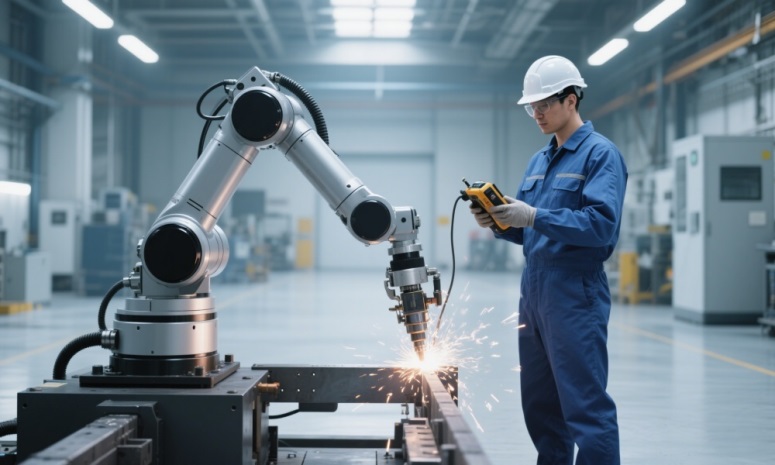
In this article, we explain how robotic welding eliminates the biological variability inherent to human craftsmanship, delivering mechanical precision, algorithmic consistency, and quality levels impossible to achieve manually.
Human craftsmanship built the industrial world, yet inherent biological limitations create variability that modern manufacturing can no longer tolerate. A skilled welder’s performance fluctuates with fatigue, distraction, and environmental conditions beyond conscious control. Minor inconsistencies in bead profile or penetration depth become critical structural weaknesses under stress. The welding robot (https://quant-robotics.com/solutions/welding-robots) fundamentally eliminates this variability through mechanical precision and algorithmic consistency that human neuromuscular systems cannot match, achieving reliability levels that human biology makes physically impossible.
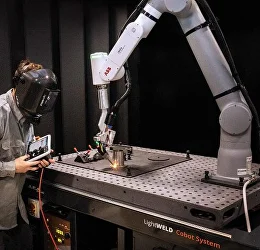
The Anatomy of Human Welding Variability
Understanding robotic welding’s superior consistency requires examining specific mechanisms through which human performance varies, even among highly skilled professionals. These aren’t failures of training but inevitable consequences of how biological systems function:
- Neuromuscular fatigue degrades precision over time. Studies show welders experience measurable declines in hand steadiness after just two hours of continuous work. The same professional producing flawless welds at shift start makes microscopically different movements by afternoon, variations invisible to the naked eye but significant at metallurgical scales.
- Visual perception limitations in bright arc environments. Welding arcs produce luminosity exceeding 10,000 candelas, forcing the human eye to constantly adjust. Welders essentially work partially blind, relying on practiced intuition rather than precise real-time feedback, introducing inevitable positioning inconsistencies.
- Thermal discomfort affects concentration and technique. Welding environments routinely exceed 40°C near work areas. As core body temperature rises, cognitive function measurably declines—reaction times slow and fine motor control suffers, regardless of determination or professionalism.
- Ergonomic constraints force compromised positions. Complex assemblies often require welding overhead, vertically, or in confined spaces where optimal body mechanics become impossible. Human welders adapt by compromising technique, accepting decreased quality as unavoidable trade-off.
These factors represent fundamental constraints of human biology operating in demanding industrial environments, not individual shortcomings. Even master welders cannot overcome physiological realities affecting performance consistency.
Mechanical Precision: The Robotic Advantage
Robotic welding systems operate under entirely different physical principles that eliminate biological variability. Mechanical and algorithmic consistency creates repeatability measured in hundredths of millimeters across millions of operations:
- Positional repeatability within ±0.05mm tolerances. Industrial robots return to programmed positions with extraordinary precision, maintaining identical torch angles, travel speeds, and work distances across unlimited repetitions. The thousandth weld executes with identical parameters as the first.
- Constant travel speed eliminates heat input variation. Weld quality depends critically on consistent energy input per unit length. Robots maintain programmed speeds with machine precision while human welders unconsciously vary pace based on fatigue or the natural impossibility of maintaining perfectly steady movement.
- Algorithmic parameter control across multiple variables. Sophisticated systems simultaneously manage wire feed speed, voltage, travel angle, and shielding gas flow with real-time adjustments. This multivariable optimization exceeds human cognitive capacity to consciously control multiple parameters simultaneously.
- Vision systems provide objective quality monitoring. Integrated cameras and sensors continuously evaluate weld bead geometry, detecting deviations invisible to human inspection. This real-time feedback enables immediate corrections rather than discovering problems during post-production testing or service failure.
The consistency advantage isn’t marginal—it’s transformative. Manufacturers report defect rates dropping by an order of magnitude, not because human welders were incompetent but because mechanical systems operate without biological constraints.
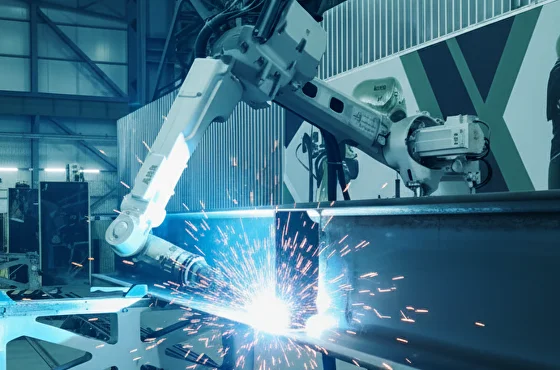
Quality Metrics: Quantifying Consistency Improvements
The transition from manual to robotic welding produces measurable quality improvements across diverse manufacturing sectors, demonstrating how consistency translates into operational and financial benefits:
- Rejection rates decrease 70-90% in typical implementations. Industries tracking weld quality before and after automation consistently report dramatic reductions in assemblies failing inspection. Parts previously requiring costly rework now pass quality control on first attempt, directly improving material utilization and production economics.
- Rework costs fall proportionally to quality improvements. Every rejected weld consumes materials and labor hours for identification, disassembly, correction, and re-inspection. Eliminating 80% of rework incidents removes entire workflow bottlenecks that previously constrained production capacity.
- Warranty claims and field failures decline significantly. Companies report substantial reductions in warranty repairs and catastrophic failures when robotic welding replaces manual processes, particularly in critical applications where weld integrity directly impacts safety.
- Process capability indices improve to six-sigma levels. Statistical process control metrics show robotic welding achieving Cpk values above 1.67, producing defects at rates measured in parts per million rather than percentages—essential for industries where rare failures carry unacceptable consequences.
These improvements compound over time, enabling tighter design tolerances, optimized material usage, and customer confidence in product reliability—competitive advantages extending far beyond simple cost reduction.
The Future of Manufacturing Quality
The transition to robotic welding fundamentally redefines what «consistent» means in manufacturing. Where human craftsmanship once set the quality ceiling, mechanical precision now establishes new baselines that seemed impossible decades ago. This consistency enables engineering advances previously constrained by manufacturing variability, allowing designs optimized for performance rather than compensating for production unpredictability. As industries demand ever-higher reliability in critical applications, the gap between human capability and robotic precision only widens. Forward-thinking manufacturers partnering with specialists like robotics engineering company Quant Robotics recognize that quality consistency isn’t just about reducing defects today but establishing the manufacturing foundation for tomorrow’s innovations requiring reliability levels human hands simply cannot deliver.